
AI implementation roadmap: a 90-day plan for useful business AI
AI implementation roadmap for teams that want a practical 90-day pilot: pick the right process, protect data, measure ROI, and scale safely.

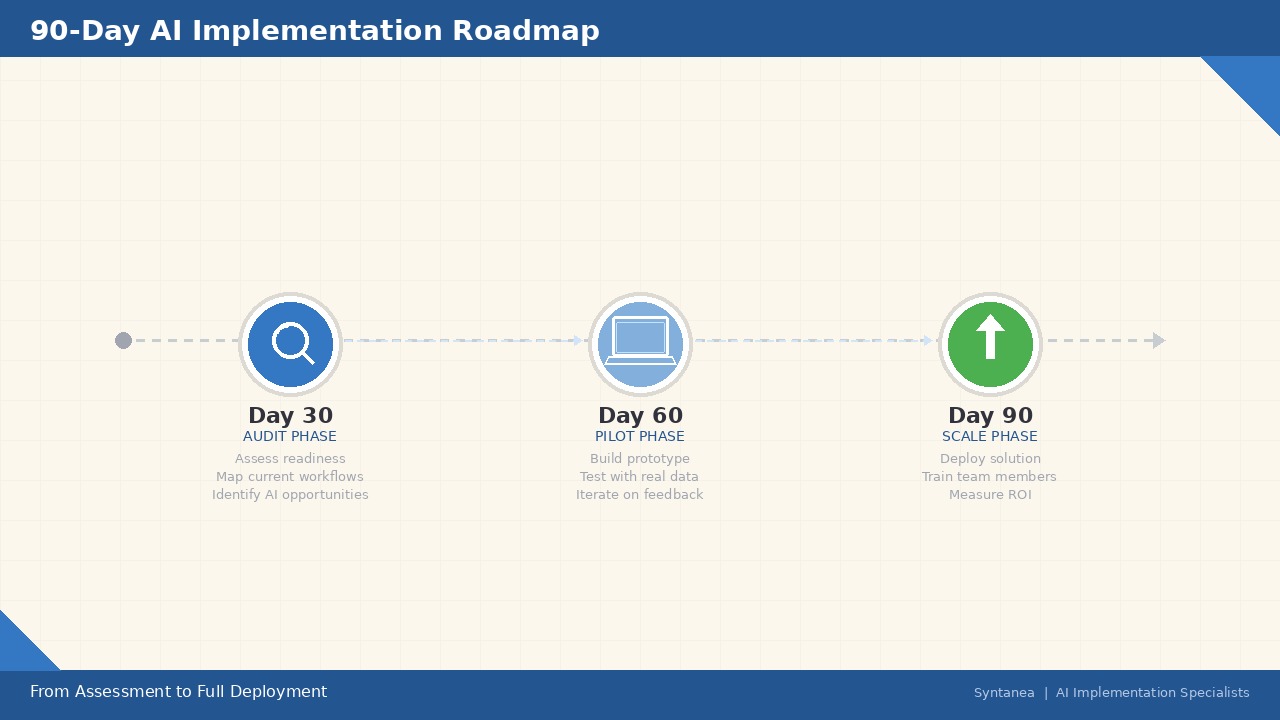
AI implementation roadmap: start with one painful process
Most failed AI projects start too big. Someone wants a company-wide assistant, a knowledge base that answers everything, or a sales bot that magically knows the business. Three months later the team has a demo, a security review, and no saved time.
A useful AI implementation roadmap is smaller and more boring. Pick one process. Measure the current pain. Build a pilot that handles a narrow part of the work. Let people test it on real cases. Then decide whether it deserves more budget.
That sounds less exciting than an AI transformation program. Good. Boring is easier to ship.
What to do before choosing AI tools
Do not start by comparing model providers or automation platforms. Start with the work. In a service company, the first AI pilot often comes from one of these places:
- Reading and classifying inbound requests
- Extracting fields from PDFs, emails, invoices, or support tickets
- Summarizing meetings, project notes, or client history
- Drafting reports from approved internal data
- Routing tasks between CRM, project, finance, and support tools
Write down how the process works today. How many cases happen per month? How long does each case take? What errors force rework? Where does sensitive data appear? If nobody can answer those questions, the first job is process mapping, not AI.
We use a simple rule: if the team cannot explain the workflow on a whiteboard in 20 minutes, AI will probably automate the confusion.
The 90-day AI implementation plan
Ninety days is enough time to prove value without pretending you can redesign the whole company. The plan below works for document processing, internal reporting, support triage, lead qualification, and similar workflows.
Days 1-15: pick the pilot and define the baseline
Choose one process with visible pain and a clear owner. Avoid strategic fog. Good candidates have repeated inputs, known outcomes, and enough examples to test against.
Baseline the current process before touching code:
- Cases per month
- Average handling time per case
- Error or rework rate
- Number of handoffs
- Systems involved
- Data sensitivity
Example: a finance team handles 300 vendor invoices per month. Each invoice takes about 8 minutes to check, code, and route for approval. Around 7% need correction because the wrong cost center or missing purchase order was used. That is a better pilot brief than "use AI in finance."
Days 16-30: design the human review loop
AI should not silently change important business data. Decide what the system may do alone and what a person must approve.
For an invoice workflow, AI might extract vendor name, amount, due date, purchase order, and suggested cost center. A person still approves the posting. For support triage, AI might classify urgency and suggest a response. A human still sends anything sensitive or customer-specific.
This step prevents the usual argument about whether AI is trusted. It does not need blanket trust. It needs a defined lane.
Days 31-55: build the smallest working pilot
The first version should connect to real inputs and produce real outputs, but it does not need every edge case. Build for the common 70%.
A practical pilot usually includes:
- Input collection from email, form, CRM, shared folder, or API
- Prompting or model calls with clear instructions and examples
- Data validation rules around the AI output
- A review screen or approval step
- Logging for decisions, errors, and user edits
- A fallback path when confidence is low
The fallback matters. If the workflow breaks every time the input is messy, people will stop using it. Let the system say, "I am not sure; send this to a human."
Days 56-75: test with real cases and measure edits
Do not judge the pilot from a polished demo. Run it on recent real cases, including awkward ones. Track what users changed before approving the output.
Useful test metrics include:
- Percentage of cases completed without correction
- Average time saved per case
- Most common correction type
- Cases routed to fallback
- User complaints or workarounds
- Any data that should not have been sent to the model
The correction log is gold. If users keep fixing the same field, improve the extraction rule or add a deterministic check. If users rewrite every draft, the task may need better source data or should stay human-owned.
Days 76-90: decide whether to scale, pause, or kill it
A pilot that does not save time is not a failure if you learn it cheaply. At day 90, make a plain decision.
Scale it if the workflow saves measurable time, users trust the review loop, error rates are acceptable, and support effort is low. Pause it if the value is there but data access, compliance, or integrations need cleanup. Kill it if the task is rare, ambiguous, or politically easier than operationally useful.
Killing weak pilots is healthy. It keeps the next AI budget available for something that actually works.
AI implementation risks to handle early
The risky parts are usually not the model. They are data access, unclear ownership, and vague success metrics.
Data privacy and client confidentiality
Before sending data to any AI service, decide what categories are allowed: public information, internal notes, personal data, client confidential data, financial data, source code. Some workflows can use hosted APIs. Others need stricter controls, redaction, private deployment, or no model at all.
Integration debt
Many AI pilots fail because the model works but the surrounding systems do not. The CRM has dirty fields. The document names are inconsistent. The finance tool has no clean API. Budget time for integration cleanup. It is not glamorous, but it is often where the value is recovered.
No owner after launch
Every AI workflow needs an owner. Someone has to review failures, update examples, watch cost, and decide when rules change. Without that owner, the pilot slowly rots and people go back to spreadsheets.
How to measure AI ROI without pretending
Keep the math simple. If a workflow runs 300 times per month and saves 5 minutes per case, that is 25 hours back each month. If the loaded cost of that work is 40 EUR per hour, the gross time saving is about 1,000 EUR per month. Then subtract tool costs, support time, and review time.
Also measure risk reduction. Fewer missed tickets, fewer wrong invoice codes, faster client responses, cleaner audit trails. These are harder to price but often matter more than raw minutes.
A pilot deserves more budget when the numbers survive contact with real work.
FAQ
What is an AI implementation roadmap?
An AI implementation roadmap is a practical plan for choosing a use case, preparing data, building a pilot, testing it with users, measuring value, and deciding whether to scale. It should include owners, risks, integrations, and success metrics.
How long does AI implementation take?
A focused AI pilot can often be built and tested in 6 to 12 weeks. Larger rollouts take longer because they involve data governance, security review, integrations, training, and process changes across teams.
What is the first step in implementing AI in business?
The first step is choosing a specific business process with repeated work and measurable pain. Do not start with the tool. Start with the workflow, the baseline, and the person who owns the outcome.
How much does an AI pilot cost?
A small workflow pilot can start around a few thousand euros when it uses existing tools and clean data. Custom AI implementations with integrations, review screens, security controls, and reporting often land in the 10,000 to 50,000 EUR range for the first useful version.
When should a company not use AI?
Avoid AI when the process is rare, the rules are deterministic, the data is too sensitive for the available setup, or the team cannot define what success looks like. In those cases, better process design or standard automation may be enough.
Need a practical AI implementation roadmap?
Syntanea helps companies turn vague AI ideas into small, testable workflows. We map the process, pick the pilot, build the integration, and keep the human review loop visible.
If your team is considering AI automation but does not want a three-month slide deck, talk to Syntanea. We can help you choose the first workflow worth testing and build a roadmap that survives real work.
Related reading
- AI automation for business — where AI saves time and where it usually fails
- Cost of AI implementation — budget ranges, hidden costs, and ROI math for AI pilots
- AI automation for finance teams — how to pick a safe first finance workflow and estimate ROI
- AI document processing automation — ROI and pilot scope for invoices, claims, and contracts
- AI email automation — a practical way to triage inbox-driven workflows
- Business process automation examples — nine workflows that are good automation candidates
- AI workflow automation — how to score and scope the first process
- Sales process automation examples — seven CRM, follow-up, and handoff workflows worth fixing
- AI inventory management automation - a practical pilot for stockouts, reorder points, and planner exceptions
- Business process audit checklist — how to audit one workflow before picking tools
- AI agents for business automation — a practical guide to safe agent pilots
- Process optimization — how to remove waste before automating